Monday, February 25, 2019

Fred and Ella -- Businesses Part 2 (1911 - 1914)

While Fred and Ella moved to Lehi, Arizona, in Spring of 1911 with the Nash family, it isn't clear when they returned back to American Falls. Not much is mentioned of the Kohlhepp's in the paper from 1911 to 1913. There is notice of roads being built through or by property.


Fred's daughter, Minerva Teichert (my great grandmother), filed notice of her intention to offer final proof for her homestead in American Falls, which she failed to do in 1913. Fred's other daughter, Annalee, graduated from high school in North Ogden in 1914, showing how the family had already been scattered apart. And Fred's sister, Amelia Piquet, moved back to American Falls in that same year. Fred's own activities only start getting documented in 1914.

1914.

In July of this year, Fred ran for the position of assessor in Power County, a county which had been formed in January 1913 and named after the electric power generated in American Falls, presumably while he was still in Arizona. American Falls was the county seat of the new county. An assessor was responsible for determining the value of each parcel of real property (land plus any structures) in the county, which had implications on how the property was taxed and could also impact sale value. Fred no doubt saw this as naturally building on his familiarity with the country, his work in real estate and land location. However, his time away in the crucial forming of he county was not in his favor. Fred announced his candidacy in the following manner:

"FOR ASSESSOR. I hereby announce myself a candidate for the office of county assessor subject to the Progressive party at the primary election to be held Sept. 1st, 1914. I am one of the oldest settlers here and have always tried to deal justly with all mankind. Can speak the German as well as the English language, and if nominated and elected to this office will try to give all a square deal. 

Respectfully,....
FRED. J. KOHLHEPP"


Fred keyed in on his experience, multicultural background, and his fairness (extending ideally beyond a Mormon audience) in his general business dealings. As mentioned before, Fred no doubt resonated some with the Progressive Party platform. He ran on that party's ticket for the election, and competed against the following individuals within and without his party:

Republican -- O. F. Crowley (American Falls, ID)
Democratic -- J. I. Allen (Rockland, ID)
Progressive - O. O. Ogden (Rockland, ID)

Notice for the Primary Election was posted in the American Falls newspaper in 1914:


Following the primary on September 1, results were shared on September 3 that showed that Fred received the fewest votes for this county office. In general, not just for this office, the Republican party received more votes for offices than the Democratic and Progressive parties combined. O. O. Ogden advanced beyond the primaries for the office of assessor for the Progressive Party.

Crowley - 331
Allen - 133
Ogden - 133
Kohlhepp - 78


The following week an abstract was given of the actual results by city for the candidates. I've clipped the relevant portions.


From it we can see that Fred got a first choice vote from 2 Republican voters in Neeley, Idaho; 3 Democratic voters in Neeley, Idaho. These were likely friends from the LDS church in that town. Then, for the Progressive Party, while Fred received the most votes in American Falls itself, he struggled in the outlying cities. He received 2 votes in Arbon, 3 from Bonanza Bar, 6 in Igo, 2 in Landing, 2 in Little Creek, 2 in Neeley, 2 in Pleasant Valley, and unfortunately only 19 in Rockland (v. O. O. Ogden's crushing 78 votes there).

As the race moved beyond the primaries, the poor Democratic and Progressive showing led towards criticism of the prominence of the Republican party. One such criticism was of an "old Republican ring that has been in power so long that is leaders are using the offices for their own financial interests and are profiting from the expense of the people in general who pay the greater part of the taxes." In response, the Republicans pointed out the 21 month old county had hardly been around long enough to have old rings of any sort. If any ring existed, it was the same sort of ring that existed in all parts of society, extending far beyond the realm of politics. One point made included Fred:

"Before closing this article it may be well to go a little further into this ring business. No doubt many will be surprised to learn that there is a ring in the Mormon church. But such is the fact. It is composed of Charles Johnson, W. W. Becksted, Fred J. Kohlhepp, and a number of other thoroughly good citizens. They wield a controlling influence in that organization, and their influence is for good. There is the same kind of a ring in control of the Methodist, Baptist, Lutheran and Catholic churches. Those who compose those various rings are the real workers--the factors, the people who do things. Then there is a county fair ring. It numbers amongst its members M. E. Drake, Frank Kluck, George Sanger, E. E. Zaring, H. C. Allen, D. W. Davis, E. E. Geesey, D. T. Farnham, S. B. Rowe, Philbrick & Greenwood, T. E. St. John, L. L. Evans, David Burrell, M. A. Wones, Mrs. Benjamin Howell, and about a dozen others. These people have done practically all the work in getting up the fairs that have been held here, giving freely of their time and in the early days of their money, and not one of them has ever received a cent of compensation. Someone has to take the lead in every undertaking and it is the public spirited men and women who do so."


Fred does not attempt to run for office again after this attempt in 1914. Instead, we see him and Ella shift to different business matters. At the end of the year there is the first mention of the Kohlhepp's first and second hand clothing and general goods store. On December 10, 1914, a basic ad reads, "If you want $1.00 to buy as much as $2.00 go to Kohlepps New and Second Hand Store. Boys' suits from 12 years up $4.95. Boys and men's all wool new, up to date suits $5.95 while they last. Children's coats from $1.00 up. Ladies coats and suits $4.00. Wool and silk shawls from 25c up. Shoes $1.99 per pair. Stoves, furniture, overcoats, etc., In the 2nd hand department. One half block south of depot."


We'll see many more notices regarding this store in the coming years.


Sunday, February 24, 2019

Fred and Ella -- Businesses Part 1 (1909 - 1911)

After Fred returned from his mission in Germany and Switzerland, he returned to earning a living. Besides ranching and farming, he and Ella ran different businesses in American Falls. In the spirit of entrepreneurship, Fred first tried his hand at land locating and real estate, trying to sell lands and help newcomers get on homesteads. Fred purchased buildings near the American Falls train depot, and while using some of the real estate for his own office, also leased out space to other businesses.

Fred's success there must have been marginal, as he and Ella migrated to Arizona in 1911, and then returned a few years later. After settling back in, Fred ran for assessor in the municipal government of the relatively new Power County in 1914. Fred was not elected. Ella and Fred then operated a new and second hand clothing and goods store. Advertisements and notices for these businesses were scattered throughout the American Falls Press, which I'll chronicle the development of in a short series of articles, with snapshots from the newspaper. This first post will cover through 1911, when the Kohlhepp's moved to Lehi (now Mesa), Arizona.

1909.

A professional looking ad first started appearing on March 27th. It stated simply in a box, "Anyone wishing to buy, lease, sell or locate land, apply to F. J. Kohlhepp, American Falls, Idaho."


This ad reappeared in many later issues: April (10, 17, 24), May (1, 15, 22, 29) June (5, 12, 19, 26), July (10, 24), August (21, 28), September (4, 11, 18, 25), November (27), October (2, 9, 16, 23, 30), November (6, 13, 20), December (4, 11, 18, 25).

The first example of space being leased from the Kohlhepp's city property in American Falls appears in the Spring of this year. On May 1, 1909, a notice in the paper stated that an "A. Kaiser, of Denver, has opened a photo studio in the Kohlhepp building, Railroad avenue. Up-to-date work and all the latest in high grade portraits. Ready for sittings April 25."


The following month, on June 12, 1909, Fred's real estate endeavors were noted. The AFP stated, "Mr. Kohlhepp has just located another man on a beautiful spring six miles from town. He located about twelve on water and has a few more places which can get water." Fred was helping folks locate homesteads where they could get water to irrigate their land and get water for livestock. This was not the first time, as it noted he'd located twelve individuals on water already, which would have been prior.


Fred advertised his capacities and property to rent in July, posted an ad that stated, "If you wish to buy, sell, lease or locate, call on F. J. Kohlhepp. Business house and rooms for rent. Improved ranches from $15 to $35 per acre." Fred wasn't just helping general new property for a homestead to be located, but also selling already improved land.


A more detailed advertisement that stressed Fred's experience appeared on September 18, 1909. Here Fred noted, "$25 per acre buys an improved ranch with independent water right, from F. J. Kohlhepp, the land locator. Have lived twenty-two years here and can show you the best homesteads and relinquishments; also city lots for sale. Office on Railroad avenue; residence, brick house north of bridge." We see the reference to his 22 years in the area (this would put him at being in the area since 1887, or 1885, if removing his years in Germany).


1910.

Fred's general real estate ad repeated in January (1, 15, 22, 29), February (5, 12, 19, 26), and March (5).

A development of Fred's business was posted in March, stating how "[F]. J. Kohlhepp has established a real estate office in the building north of the First National bank. Mr. Kohlhepp has lived here for upwards of 25 years and is thoroughly familiar with the country." Notice the jump in 3 years of being in the area within less than 3 months (perhaps this time inclusive of his time in Germany). Fred's office is located relatively to being just north of the First National bank. There's some practical benefit to being so located -- one can go next door to get the loan to then purchase the land.


A couple weeks later an ad stated, "It costs nothing to list your property with F. J. Kohlhepp and may bring you a speedy buyer, as he has letters from all parts of the country and expects many buyers soon, so DON'T DELAY." Fred was allowing people to give free listings to help speed up his business. His language expressed the availability of buyers, which folks not making listings were missing out on.


Later in March, the ad evolved twice. First on, March 12, it called out "THE EARTH IS BEING DIVIDED. Don't come too late for your share. FREE HOMESTEADS, Improved Dry and Irrigated Land, City Property. F. J. Kohlhepp. Twenty-three years here and can show you the best."


The following week the ad became slightly modified: "Free Homesteads. The Earth is being Divided. Don't Come Too Late for Your Share. Kohlhepp & Co. Land Locator and Real Estate Agent. 23 years here. First dry land farmer in this location. Office, Corner West of U.S. Land Office. Residence, brick house north of bridge. American Falls, Idaho." This time Fred advertised his company, not just himself, noted his being first dry farmer in the area to further underscore his credibility in helping newcomers locate a homestead. It also further located his office as relative to the U. S. Land Office. This same ad appeared in the April (2, 9, 16) issues.


Later that year in December (starting December 10), notices appear of other businesses leasing space in his property. One notice read, "For Health and Beauty: Massage and Hairdressing Parlors, in the Kohlhepp block, Railroad avenue. Switches, Puffs and Curls made to order. Wrinkles rmeoved. Massage treatment for all ailments. Sea salt and medicated baths at your home, by appointment."


1911.

At the start of the year on January 21, 1911, there was a notice for the "Hammock Cleaning and Pressing Co. Kohlhepp Bldg. Railroad Avenue. All Work Guaranteed." This gives us a sense of some of the businesses that leased space from Fred.


Sunday, February 10, 2019

Homestead on Cold Creek

On May 20, 1862, Abraham Lincoln signed into law the Homestead Act. This monumental act fostered Western migration by providing frontier settlers 160 acres of public land (surveyed government land). In exchange, homesteaders paid a small filing fee and were required to complete five years of continuous residence ("proving up" the land, building a home and planting crops) before receiving ownership. After six months of residency, homesteaders also had the option of purchasing the land from the government for $1.25 per acre. The Homestead Act led to the distribution of 270 million acres of public land (~10% of the continental US) to private citizens.

While the Act encouraged many would-be homesteaders, its minimal and seemingly lenient requirements proved deceiving. For many, the requirements became insurmountable. Many homesteaders took claims with little or no farming experience, and growing crops in the harsh conditions of the West was a difficult task for even the most seasoned farmers. Many homesteads in the arid plains were too small to yield a profitable crop, and the cost of irrigation far exceeded the value of the land. Over the 124-year history of the Act, more than 2 million individuals filed claims. Of these, only 783,000 -- less than half -- ultimately obtained the deeds for their homesteads.

Fred and Ella Kohlhepp, along with their children, were among those that homesteaded lands, and not all were successful. One set of 160 acres, up on Cold Creek near the settlement of Neeley, was proved up by Fred and Ella, and ended up being what the Kohlhepp children considered "home." They filed notice at the land office at Blackfoot, Idaho on April 5th, 1897, of making their proof of their five year term, which was recorded in the April 24, 1897 Blackfoot News:

"Notice for Publication.

Land Office at Blackfoot, Idaho,
April 5th, 1897.

Notice is hereby given that the following named settler has filed notice of his intention to make final proof in support of his claim and that said proof will be made before the Register & Receiver at Blackfoot, Idaho, on May 20th, 1897: viz. Fred J. Kohlhepp, on E. No. 2827, for the E1/2 of NE1/4, NE1/4 SE1/4 of Sec. 19, NW1/4 of SW1/4, Sec. 20, Twp. 8 Range 31 East.

He names the following witnesses to prove his continuous residence upon and cultivation of said land, viz:

William Neeley, Christ[ina] Neeley, Pr[?] Dilley, Ella Kohlhepp, all of American Falls, Oneida County, Idaho.
JNO. G. BROWN, Registrar"


This proved successful as the land grant records attest:


Homestead Certificate No. 2187
Application 2827
The United States of America,
To all to whom these Presents shall come, Greeting:
Whereas, There has been deposited in the General Land Office of the United States a Certificate of the Register of the Land Office at Blackfoot Idaho, whereby it appears that, pursuant to the Act of Congress approved 20th May, 1862, “To secure Homesteads to actual Settlers on the Public Domain,” and the acts supplemental thereto, the claim of Fred J. Kohlhepp has been established and duly consummated, in conformity to law for the east half of the north east quarter and the North East quarter of the south East quarter of section nineteen and the North West quarter of the South West quarter of section twenty in Township eight south of Range thirty one East of Boise Meridian in Idaho containing one hundred and sixty acres according to the Official Plot of the Survey of said Land, returned to the General Land Office by the Surveyor General.
Now know ye that there is, therefore, granted by the United Stated unto the said Fred K. Kohlhepp the tract of Land above described: TO HAVE AND TO HOLD the said tract of Land with the appurtenances thereof, unto the said Fred K. Kohlhepp and to his heirs and assigns forever; subject to any vested and accrued water rights for mining, agricultural, manufacturing, or other purposes, and rights to ditches and reservoirs used in connection with such water rights as may be recognized and acknowledged by the local customs, laws, and decisions of courts, and also subject to the right of the proprietor of a vein or lode to extract and remove his ore therefrom, should the same be found to penetrate or intersect the premises hereby granted, as provided by law, and there is reserved from the lands hereby granted, a right of way thereon for ditches or canals constructed by the authority of the United States.
In testimony whereof, I William McKinley, President of the United States of America, have caused these letters to be made Patent, and the Seal of the General Land Office to be hereunto affixed.
Given under my hand, at the City of Washington, the Fifth day of August, in the year of our Lord one thousand eight hundred and Ninety seven, and of the Independence of the United States the one hundred and twenty second.
By the President, William McKinley
By F. M. McKean, Secretary.
C. H. Brush, Recorder of the General Land Office.


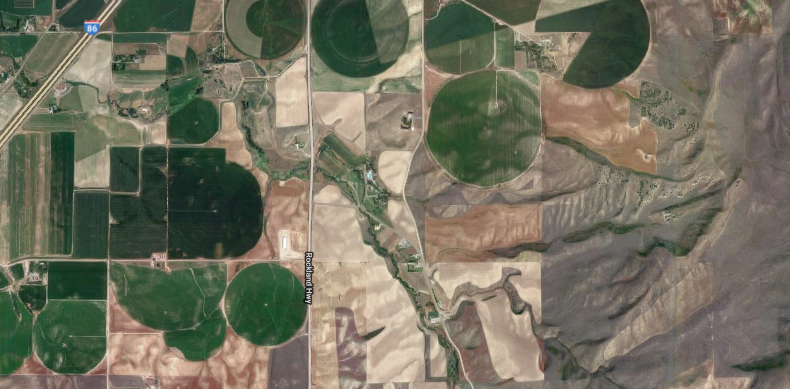
Enjoyably, this grant of land can be mapped easily to real property today. Here is a visualization thanks to the government:


Sunday, February 3, 2019

Photos: Ella (1936)

Ella and her second husband, George Martineau, attended George's youngest son's (Thouis Martineau's) wedding to Mabel June Tyler on May 22, 1936. That day, a picture was taken, which included Ella.


From left to right we see: Mabel Tyler, Thouis Martineau, Matilda Petersen, George Albert Martineau (Sr.), and Ella. It's not the best photo of Ella. Her eyes look closed, and her hand is blurred.

Saturday, February 2, 2019

Ella -- Notes from Martineau Family

After Fred died, Mary Ella remarried 9 years later in Salt Lake City to George Albert Martineau, Sr. There isn't a lot captured in my family history after this point, due to the rift that formed between Minerva and Ella. I've looked up memoirs that the Martineau family might have had, and did discover some tidbits. From a biography of George Albert Martineau by his grandson, LeVan Martineau, there are a few notes about Mary Ella of interest:

"George moved back to Cedar City, Utah in 1927. In 1928 he moved to Salt Lake City. While in Salt Lake he met Mary Ellen [Ella] Kohl[h]epp. She was a widow who had six children. All of them were married but one. They were married December 5, 1928. (Mary Ellen was a health food fanatic and grew alfalfa in the living room window and used the leaves to make salad and juice. She had some other ideas about health that were not very sound. She believed that if a child looked directly into the morning sun for several minutes a day they would have strong eyesight. A very bad thing to do. Thouis told of having his father come to visit, after he and Mabel were married, and they were cooking beef steak for dinner. George Albert explained very carefully about how they were strict vegetarians and ate only healthy food and never red meat. He then sat down to dinner and ate all the steak. Another bit of interest, George kept the upright piano that was in her home and moved it to Arizona with him.  He shipped it to his youngest son, Thouis, for Christmas in 1954. It was given to his middle child, Carol Stoddard, who has it in her possession (1998). Mary Ellen died of dropsy in January, 1941. (Dropsy, now called Edema, is an abnormal accumulation of fluid in cells or a tumor.)"

Observations:

- Notes marriage date to George Albert Martineau, Sr. on December 5, 1928.
- One child not married I believe would have been Constance.
- The belief regarding eyesight may have contributed to Minerva's description of lost eyesight in her letter to her daughter Laurie.
- It looks like the regiment reg. food consumption was instituted not only at the Kohlhepp home, but the Martineau home as well. This was the "Jewish" health code they claim to have followed. George looks to have begrudgingly followed it.
- We know Ella composed music, and it's interesting to see where her piano ended up. It would be interest to see if Carol had any pictures of it.


Tuesday, January 29, 2019

Johann Friedrich -- Dye Works Damages (1868, 1884)

In a prior post, I noted how between the years 1884 and 1886, Johann Friedrich's dye work factory disappeared from the maps for Jamaica Plain.

1884:


1886:


I was curious if I could uncover any explanation for the difference here, and I have found some more material explaining it. Snippets from Boston newspapers, namely the Boston Globe, the Boston Traveler, and the Boston Post have allowed me to piece it together.

In 1884, a few articles appear on Johann's property. First, he petitions for redress on damages to his property that resulted from the city's work on Stony Brook that ran through his land, which began in 1868 and were finally coming to a head. This request is handled by appointees from the Board of Alderman.

From the May 6th issue of the Boston Traveler:

"Alderman Curtis submitted a report from the Committee on Stony Brook on the petition of Frederick Kohlhepp and others, to be paid for land taken, and for damages occasioned by the improvement of Stony Brook -- That in their opinion the claim is not properly before them, inasmuch as by the provisions of Chapter 196 of the Acts of 1874 the Board of Aldermen are solely empowered to settle claims of this character. They therefore recommend that the claim be referred to the members of this committee on the part of the Board of Alderman.

Accepted and referred accordingly. Sent down.

Alderman Curtis offered an order--That His Honor the Mayor be authorized to appoint three suitable persons who shall determine the amount of betterment the Board of Aldermen may assess upon the estates bordering upon Stony Brook, on account of the improvement of the channel of said brook by the city of Boston, as provided in Chapter 196 of the Acts of 1874."


In the following week's (May 13th) newspaper, it reports the results of this committee, where they provide $1000 of the requested $3500 for the damage done to Johann's property. There are interesting descriptions of his manufacturing buildings being removed as a result of the improvements and damage done to his equipment, which would have impacted the Dye Works. We also see issues with fulfilling his business obligations to someone leasing his property, for which he got sued.

"Stony Brook.

Alderman Curtis submitted a report from the Committee on Stony Brook, on the petition of Frederick Kohlhepp and wife to be compensated for land taken and damages occasioned by the Stony-brook Improvement, that, having heard the petitioners, they recommend the passage of the following:

Ordered, That there be paid to Frederick Kohlhepp the sum of $1000 for all damages occasioned to his estate by the improvement of Stony Brook under Chapter 223 of the acts of 1868, or chapter 196 of the acts of 1874, or any acts relating to said improvement whether done by the town of West Roxbury or the city of Boston, upon his giving to the city a deed or release satisfactory to the city solicitor, granting to the city of Boston "the right and privilege to keep and forever maintain at its own proper cost and expense the new channel of Stony Brook, through the land of said Kohlhepp, at its present width, and to maintain and repair the stone walls on either side of said channel at their present height and width, and to enter on the same for the purpose of repairing and cleaning the said channel and walls, and of removing any obstructions to the free flow of the water in the said new channel of said brook, and an acquittance and discharge for all damages, costs, and expense in concequence of the taking and of other acts of said town or city;" said sum to be charged to the appropriation for Stony Brook Improvement.

Alderman Curtis -- This case was begun in 1868, and had been wending its way down through the courts and the city government until the present time. Their claim was $3500. We gave the party quite a number of hearings, and have finally compromised for $1000. The channel of the brook was changed from the line where it went through this man's land. His manufacturing buildings were removed and his machinery was destroyed or injured to a great extent. His building was let at the time, he was sued by the lessee, and judgment was rendered against him. He has been in court about as long as he wants to be. He came to this Board for redress in 1881. We have now agreed with him upon a settlement which I think is fair and equitable, and it does not take away the right of the city to assess betterments upon his land for the improvement of the brook. He has accepted our terms, and I think it is no more than fair and just that he should be paid.

The order was passed. Sent down."


This order being passed is described in the May 13th issue of the Boston Globe too, where it briefly notes, "to pay to Frederick Kohlhepp $1000 for damages occasioned to his estate by the improvement of Stony brook."


With this cleared up, it still doesn't answer how Johann's land was impacted between 1884 and 1886. What transpired in those proceedings was of a historical nature in the 1860's.

What really spells out what happened to the land is an article in the December 20th 1884 issue of the Boston Traveler. A fire broke out and burned his building:

"Alarm from 521 at an early hour today was occasioned by a fire in the dye house of Fred Kohlhepp, at Jamaica Plain, which before the firemen could get under control had badly damaged the building. The loss was placed by an employee at $3900 and is covered by an insurance of $1000.

It is estimated that the loss on the fire, which partially destroyed the building of Joseph H. Curtis of Jamaica Plain, will reach $8000, which is covered by insurance. A. A. Bestwick of Engine 28 had his right arm broken by a hose stricking him, while he was on a ladder player on the fire."


From the maps, it appears that the fire took the Dye Works building out of commission altogether.


Photos: Fred and Ella - 1910's

For my next photo, I'll share one of Fred and Ella that I've also restored, removing some slight scratches, a tear, and some imperfections. I've included both a more distanced and zoomed in view. Feel free to click and see more of the detail. Ella is looking to the side with a somewhat distant look, while Fred has a penetrating look right at the camera with his one eye. You can get a really good view of Fred's bad right eye that trails to the right. And what a mustache and beard! Fred is looking quite withered and "consumed" here, so I suspect that this photo was taken only within years of the end of his life (1915-1919). I suspect that in the background is the Snake River.


Sunday, January 27, 2019

Photos: Ella - Late 1930's

Joan Sowards, a descendant of Eda Kohlhepp Lisonbee, posted a photo of Ella in her old age with her second husband, George Albert Martineau, Sr. I took the liberty of restoring the photo, removing flecks and imperfections (inc. the orange stain), and increasing contrast to reduce the fade of time. It turned out pretty well:


Joan Sowards dated the photo to circa. 1940. Ella here does look very similar in her pose (and outfit) as to her obituary photo, her face roughly at a mirror image to the one here. Joan noted the baby as James Lisonbee. The only James I am familiar with was Eda's son, James Rey, but that can't be right as James was born before Ella and George married. Joan is likely referring to another James I do not know of (a son of Eda's sons Lorenzo or Ovid?).

I'll be restoring and posting photos as I collect them.

Ella's Obituary (1941)

Document Type: Obituary
Document Date: January 13, 1941
Created by: Deseret News
Addressed to: Newspaper readership
People referenced: Mary Ella Hickman, George Martineau, J. Grant Iverson, Williams Adams Hickman, Minerva Wade Hickman, surviving descendants via Fred and stepchildren


Fred's spouse, Mary Ella Hickman ("Ella"), lived another 22 years after Fred passed away in 1919. 9 years after he passed away, Ella married George Albert Martineau, Sr., who was also a widower. George would outlive not only his first wife and Ella, but 2 others (Emeline E. Ellsaesser and Ida Billingsley). This was a man that did not like to be alone. When Ella passed away in 1941, an obituary was printed in the January 13th issue of the Deseret News (page 5), which read:

"Martineau Funeral Set

Active Church Worked Passes at 75

Funeral services for Mrs. Mary Ella Martineau, 75, of 270 Vine Street, who died Saturday morning in a local hospital, will be held tomorrow at 11 a.m., at 36 East Seventh South Street, by Bishop J. Grant Iverson of the Capitol Hill Ward. Burial will be in the North Ogden Cemetery. Friends may call at the place of funeral prior to services.

A daughter of William Adams and Minerva Wade Hickman, she was born in Murray, Sept. 28, 1865. An active Relief Society member, she has been an active Temple worker for the past 15 years. She had also been recognized as a writer and artist.

Surviving are her husband, George A. Martineau; a son, Frederick Kohlhepp of Plymouth, Utah; six daughters, Mrs. Marie K. Nash and Mrs. Constance Shivley of Salt Lake; Mrs. Eda Lisbonbee and Mrs. Sara Bird of Mesa, Ariz.; Mrs. Minerva Teichert of Cokeville, Wyo., and Mrs. Annallee Averill of Los Angeles, Calif.; four stepsons, George A. Martineau Jr., of Sandy, T. Louis Martineau of West Jordan, Ernest Martineau of St. David, Ariz., and Douglas Martineau of Moapa, Nev., three step daughters. Mrs. Elazadie Hurst of Payson, Mrs. Nola Bauer of Mesquite Nev., and Wilma Luke of Junction, Utah; 76 grandchildren and 16 great-grandchildren."

Observations:

  • This puts Ella's death date at January 11th, 1941, and burial on January 14th.
  • The North Ogden cemetery was apparently a family plot for the Wades.
  • Ella is described as quite involved in temple work (15 years), prior to when she would have met George.
  • Recognized as an artist -- this goes along with the musical compositions, stories, and art contests I'd seen her involved in.


Saturday, January 26, 2019

Journey to Lehi (Mesa) Arizona in 1911

Document Type: Memoir
Document Date: Approx. Spring 1972
Created by: Frederick Kohlhepp Nash
Addressed to: Funeral Services for Wilbur Roy Nash
People referenced: Wilbur Roy Nash, Mary Ella Hickman Kohlhepp, Frederick Kohlhepp


Frederick Kohlhepp Nash, Fred's eldest grand child via his daughter Marie Elizabeth Nash (although Frederick Kohlhepp Nash was from Marie's prior marriage to Daniel Bertoch), recounted the trek his family (with his step father, Wilbur Roy Nash) took from American Falls, Idaho to Lehi, Arizona (which became part of Mesa) at his father's funeral (1972). His grandparents, Fred and Mary Ella, also made the journey.

"Springtime 1911

Two families decided to move from American Falls Idaho to Lehi Arizona, near Mesa. I had never seen an automobile so teams and wagons did the job in 6 weeks time by driving hard over trails that were not even a wagon track in places.

To save time we went thru Salt Lake City down Redwood road, missing City center. Traveling through Richfield and crossing Lees Ferry was quite an experience for a groupe of strangers. As a kid it was fun to sit [on] the log ferry and dangle my feet in the river as we crossed.

As we approached the Moen[kopi] Wash we saw people camped across the swol[l]en stream. They said there is no chance to cross. We have been here 2 weeks and the high water has not gone down a bit.

Our hay & food supply were very limited so it was necessary for us to avoid delay and hurry to plant Spring crops. Dad took the tallest horse across the river in different places but water was over his back at [e]very crossing. The group called me from playing in the mud to kneel in a big circle and they prayed for the water to go down.

We got in the wagons as the water went down. I sat in the bottom of our wagon and didn[']t get wet. The gentiles saw what happened, rushed to load their outfit but the river was high again before they could harness the teams. Wonder how long they had to waite. I do believe the Lord helped Ancient Israel cross waters too.

We had a donkey that ran loose and followed us like a dog. At times he was ahead but usually tagging. We met some miners using a beautiful sorrell pony as a pack animal. When the two owners met they grinned and one said ["]shall we?["] ["]Yes[,"] said the other, so our burrow go the pack in the hills and I got a pony to ride when [I got] tired s[i]tting in the wagon. Also others rode him at times.

One ni[ght] we camped in the forest and I tagged dad as he unhooked the team. Flies must have bothered the horses as one slapped my face with his tail so hard I still remember the sting. Dear dad was my real pal. He made a swing with his lasso rope and a tall tree.

We stopped at a cattle ranch and the fine lonesome cowboys treeted us like royalty, feeding us like kings. They sure were good cooks. Mashed potatoes with gravy and all the trimmings with beef.
Mother hinted that I would like some milk. They had no milk cow so they threw a wild herford and proudly presented fresh milk.

After crossing the Colorado river we had to go up a LONG steep, narrow dugway out of the Grand Canyon. I sat on the cliff hang over side to see the canyon. After crossing the Colorado river we drove up the LONG Steep narrow dugway out of grand canyon. I sat on the river side of the seat and watched the horse step so close to the edge I was scared every step for miles it seemed. Someone asked[, "]what if we meet a rig coming down on this narrow dug way?["] ["]People have taken wagons apart to pass[,"] they said.

Another thing of interest to a kid was hundreds of prair[ie] dogs in the big petrified forest. Going thr[ough] Flagstaff we passed a saw mill where they pulled logs with oxen. They never heard of oil shortage either. Painted Desert was a sight to remember when you see it at slow wagon speed.

On the farm in Lehi Dad built us a new air cooled home. Walls were 4 ft high boards and screens above on all sides so breezes came from all directions. Grand parents lived next door also in a house with dirt floors."

Observations:
  • Fred Nash would have been very young at this time, about 4 years old (he was born in 1907; this journey was in Springtime 1911). It's hard to imagine that he recalled the journey that well; a lot of the story would had to have been filled in by it being retold to him by other family members.
  • Six weeks journey; quite the trek. How well known or travelled was the route they took if not even wagon tracks could be spotted in areas?
  • The river receding episode has been recounted in another Kohlhepp story, albeit in different circumstances.
  • I plotted out the places mentioned in Fred Nash's account. I've been tempted to look for some old Utah trails and try to determine the most probable course the took down to Lehi, Arizona. In the meantime, enjoy the google map.


  • Fascinating description of the living conditions in Lehi for both the Nash and Kohlhepp families.