Showing posts with label 1911. Show all posts

Sunday, March 10, 2019

Amelia, Gus & Fred Piquet -- Idaho Sojourns

Fred's sister, Amelia, joined the LDS Christian Church, and moved out to Idaho with her children, Augustus (Gus) and Fred. She spent two major periods of time in Idaho, moving temporarily back to Boston to care for her and Fred's father, Johann Friedrich, prior to his passing. Afterwards, she returned once more to Idaho. During her first residence in Idaho, Amelia didn't live near Fred in American Falls or Rockland, choosing instead to make it in the vicinity of Blackfoot, over in Rich, Idaho, over the southwest, on the other side of the Snake River. Some information about Amelia and her sons is available in the Blackfoot, Idaho, newspaper, The Idaho Republican.


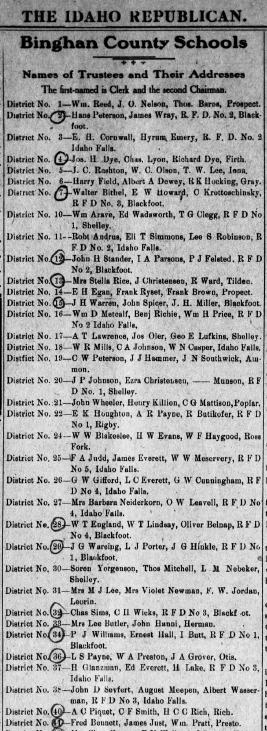
Besides building a home and improving land for a farm (described as being below the Watson Ranch), the Piquets got involved in other matter. Amelia's son Gus was made in 1905 the constable for the Rich precinct, which he served in that capacity through 1907. He served in other county positions -- as a polling judge, and as a clerk for the Bingham County school district.




When Amelia moved exactly back to Boston is unclear. In June 1907, Gus got married and moved over to Blackfoot.


Shortly after Gus moving out, and no doubt struggling to think of how to manage the farm without him, Amelia put her farm up for lease. In August 1907, we see notices in the 16th and 23rd newspapers:


We see notes sharing Amelia was in Boston (back at her father's place on Brookside Avenue), the earliest of which started on December 25, 1908.


We see others later in November 1909 and June 1911:


Amelia kept subscribing with and corresponding with the newspaper to get updates on her Idaho friends, as well as her boys. Some of this correspondence was published and contained interesting notes. One such letter from January 18, 1910 (and published in the February 11, 1910 IR issue) stated:

"Mrs. Amelia Piquet

Mrs. Piquet, who formerly lived a short distance south of Thomas and near the old Watson ranch, writes from the suburbs of Boston as follows:

Jamaica Plains, Jan. 18, 1910.

Mr. Trego,

Dear sir: I have received your hearty greetings of the 10th and I can understand the spirit of it, we do indeed need to gain a little fun from one another once in a while to keep life sweet and while dull care away. But I have not much of an account to give of myself since I left Blackfoot. I am keeping house and taking care of my father, who is all alone and is now eighty-four years old. He has been living in the same house for the last 44 years. Our house is within three minutes walk of the Franklin park, which is very beautiful with lots of wood land. I love the wood, and I missed it so much while I lived in Blackfoot, and then we have the beautiful Charles river near us where we can go boating in the summer. Still I often tell my friends here of the wonderful Snake river in Idaho just back of where I use to live and the lively trout we use to have from that river, and some how I am always praising up Idaho. I have met a number of Mormon elders here this winter from near Blackfoot, they say they are doing well at their mission work, and have a good attendance at their meetings and like Boston, but would not like to live here always. Well Mr. Trego I don't know if you can make any use of this letter, but you have all my good wishes for the success of your paper and can be sure that I enjoy reading it. Yours truly,

Amelia Piquet

P.S. If you have any Free Masons among your readers of your paper perhaps they will be interested to know that the Morning Stare lodge No. 13 of Woonsocket, R.I., are celebrating their one hundredth anniversary this month from the 23[rd] to the 27th. My good father has been a member of this lodge over 50 years."


After her father's passing in 1912, Amelia returned the summer of 1913 to Idaho. An article on July 11, 1913 captured some of the detail:

"Mrs. Piquet Returns

Mrs. Amelia Piquet who left here seven years ago take up her home with her aged father in Boston, returned to Blackfoot the first of the week, and expects to remain a couple of months or more.

Mrs. Piquet once owned some land near the original Watson ranch at Thomas, and now she has some other property in this locality. Her son Augustus who lived in the Kennedy addition has removed his family to Bates in the southeast corner of Madison county, near Driggs, and she will visit there for a while during the hot weather.

Mrs. Piquet related an incident of what an awful shock she received three or four years ago when she received her copy of the Idaho Republican and thought her son was dead. Augustus was driving the delivery wagon for the Blackfoot Stream laundry and the paper came to her with an article head, "Laundryman Fell Dead," and went on to say that a very unexpected thing happened to the driver a few days ago. He went to the Trego house for a sack of clothes as usual and Mrs. Trego told him how well pleased she and her husband were with the way they were finishing off the linen since they installed their new machine. That so much of their work was equal to that done in Salt Lake, it was the duty of the home people to have their work done at Blackfoot and stand by the man who was developing  this home industry.

Mr. Piquet was so surprised at receiving an acknowledge in lieu of more or less complaining which are always freely given, that he figuratively fell dead. His mother nearly collapsed at the introduction, but regained her strength while she finished reading the article."


 I found the article that rightfully gave Amelia such a scare:


As well as another discussing Gus' duties:


 In 1914, an article noted how Amelia moved closer to where Fred resided in American Falls:


Tuesday, March 5, 2019

Fred and Ella - Move to Lehi (Mesa) in 1911

It isn't clear exactly when Fred and Ella moved to Lehi, Arizona. Frederick Kohlhepp Nash reported that his family and his grandparents (Fred and Ella) moved there in the Springtime of 1911. However, there are records that question this timeframe by at least a few months. In 1911, there are a few notes about the Kohlhepp's. One of the Kohlhepp girls was noted as playing in the position of Center for her basketball team. They got shut out by the Pocatello team in February 1911:


Most importantly, a notice appeared in the June 22, 1911 issue of the American Falls Press regarding the timing of the move:

"Mrs. F. J. Kohlhepp left for Los Angeles the first of the week for a short visit, after which she will go to Mesa, Nevada, to make her home. She has been advised to seek a lower altitude on account of failing health. Mr. Kohlhepp will be here for some time yet. Mr. and Mrs. Kohlhepp have resided in this locality for many years, and are classed among the early settlers. It is to be hoped that the change will prove beneficial."


The following is of note:

(a) What would have taken Ella out to Los Angeles?
(b) This places Ella moving down to Mesa in the early summer of 1911, not the spring time.
(c) The move for Ella sounds motivated by personal health reasons. Was this the rheumatism that was often referred to?
(d) Fred is described as still being there (in American Falls) for some time yet, suggesting he perhaps did not go down with Ella at the same time. Yet it's hard to imagine Fred taking the trip himself?

We do see a sales notice in the American Falls Press the next week for items owned by Fred:


Sunday, March 3, 2019

Old American Falls -- Locating the Kohlhepp Building/Block at the Old Town Site


The town of American Falls, Idaho, is not located today where it was founded. Referred to at times as "America's Pompeii," American Falls' original town site now lies buried, not underneath volcanic ash, but underneath the waters of a manmade reservoir resulting from a dam. Many other homes were flooded as a result of this project approved by the Department of Interior, including my great grandparents' (Herman and Minerva Kohlhepp Teichert) cabin at the Snake River bottoms. Minerva wrote of the flooded area in her short book, Drowned Memories.


The idea for the dam had been discussed, but was formally proposed in 1919, the year Fred died. It was approved in 1920, and over 6 years plans were put in place and executed for the compensation of businesses (OSL, electric), raising of the railroad bridge, and the relocation of residences from the old town site to nearby higher altitude land. It cost the government $2.85 million to execute this migration and compensation project. If we account for inflation, that's $40,993,098.50 in 2019. Not a cheap endeavor.

The migration chiefly happened between 1925 to 1926, and involved homes being transported on steam powered engines, while some smaller structures were transported by horse teams. Imagine church buildings, large agricultural buildings, and so on, being carted away on wheels to new locations. That's what happened. Of course, not every structure could be (or was practical) to move. Some were demolished, others left simply to be flooded by the reservoir. The drowned town site, while typically submerged, is sometimes visible when the water levels of the reservoir recede. They can be seen in some videos, like the one below.

Given the relocation of the town in its young age, it is hard to document and imagine American Falls in its original town site. Yes, there are some pictures, but they do not exist aplenty. The records I've come to appreciate the most are the Sanborn fire insurance maps that were conducted in 1907 and 1911 respectively. The 1911 maps, in particular, give a fair layout of the town, with the railroad bisecting old American Falls:


The task I took upon myself was to determine if I could locate the Kohlhepp's commercial building, where they leased space, Fred worked for a while as a real estate agent, and where the second hand store was located. I believe the answer, surprisingly, is yes. There are enough documents giving the location of the Kohlhepp building relative to other businesses and buildings that its location can be fairly affixed. Here's the general section of town (section 4 in the Index above) to which the Sanborn fire insurance maps cover where Fred's building resided:


I'm actually quite lucky that it existed in a region that was indeed covered. Several key data elements helped me zero in on the location:


(a) Several ads mentioning it was off of Railroad Avenue:


(b): Several ads mentioning it was south of the railroad depot by 1.5 blocks:


(c): An article noting that it was adjacent to 1 lodging house (only 2 feet away), very close to another lodging house (with a vacant lot separating the buildings), and near the Cottage Hotel:


(d) The Cottage Hotel had burnt down in May 1911, just six months prior to the 1911 Sanborn fire insurance maps being made, suggesting that some indicator of burnt down structures should exist.


(e) The Cottage Hotel was off of Chestnut Avenue:


(f) A meat market was near the Cottage Hotel:


I was able to account for all of these facts. So here is a detailed shot of the Kohlhepp building with the surrounding businesses that I identified (notice the vacant lot in between the Iowa Rooming House and the Kohlhepp building too), which was indeed 1.5 blocks south of the railroad depot:


If you go back to the 1907 Sanborn fire insurance maps, you can see the Cottage Hotel was still around then as would be expected. You can also see a restaurant that had been in business before shutting down in the 1911 vacant spot next to the Kohlhepp building.


It's fun to locate my ancestors' building in this map of the drowned town. I am curious if the building was relocated or left to be flooded when the American Falls dam was built. If left to be submerged, could its foundation be found amongst those that appear when the water recedes? See this fun video of the exposed old town site:


Monday, February 25, 2019

Fred and Ella -- Businesses Part 2 (1911 - 1914)

While Fred and Ella moved to Lehi, Arizona, in Spring of 1911 with the Nash family, it isn't clear when they returned back to American Falls. Not much is mentioned of the Kohlhepp's in the paper from 1911 to 1913. There is notice of roads being built through or by property.


Fred's daughter, Minerva Teichert (my great grandmother), filed notice of her intention to offer final proof for her homestead in American Falls, which she failed to do in 1913. Fred's other daughter, Annalee, graduated from high school in North Ogden in 1914, showing how the family had already been scattered apart. And Fred's sister, Amelia Piquet, moved back to American Falls in that same year. Fred's own activities only start getting documented in 1914.

1914.

In July of this year, Fred ran for the position of assessor in Power County, a county which had been formed in January 1913 and named after the electric power generated in American Falls, presumably while he was still in Arizona. American Falls was the county seat of the new county. An assessor was responsible for determining the value of each parcel of real property (land plus any structures) in the county, which had implications on how the property was taxed and could also impact sale value. Fred no doubt saw this as naturally building on his familiarity with the country, his work in real estate and land location. However, his time away in the crucial forming of he county was not in his favor. Fred announced his candidacy in the following manner:

"FOR ASSESSOR. I hereby announce myself a candidate for the office of county assessor subject to the Progressive party at the primary election to be held Sept. 1st, 1914. I am one of the oldest settlers here and have always tried to deal justly with all mankind. Can speak the German as well as the English language, and if nominated and elected to this office will try to give all a square deal. 

Respectfully,....
FRED. J. KOHLHEPP"


Fred keyed in on his experience, multicultural background, and his fairness (extending ideally beyond a Mormon audience) in his general business dealings. As mentioned before, Fred no doubt resonated some with the Progressive Party platform. He ran on that party's ticket for the election, and competed against the following individuals within and without his party:

Republican -- O. F. Crowley (American Falls, ID)
Democratic -- J. I. Allen (Rockland, ID)
Progressive - O. O. Ogden (Rockland, ID)

Notice for the Primary Election was posted in the American Falls newspaper in 1914:


Following the primary on September 1, results were shared on September 3 that showed that Fred received the fewest votes for this county office. In general, not just for this office, the Republican party received more votes for offices than the Democratic and Progressive parties combined. O. O. Ogden advanced beyond the primaries for the office of assessor for the Progressive Party.

Crowley - 331
Allen - 133
Ogden - 133
Kohlhepp - 78


The following week an abstract was given of the actual results by city for the candidates. I've clipped the relevant portions.


From it we can see that Fred got a first choice vote from 2 Republican voters in Neeley, Idaho; 3 Democratic voters in Neeley, Idaho. These were likely friends from the LDS church in that town. Then, for the Progressive Party, while Fred received the most votes in American Falls itself, he struggled in the outlying cities. He received 2 votes in Arbon, 3 from Bonanza Bar, 6 in Igo, 2 in Landing, 2 in Little Creek, 2 in Neeley, 2 in Pleasant Valley, and unfortunately only 19 in Rockland (v. O. O. Ogden's crushing 78 votes there).

As the race moved beyond the primaries, the poor Democratic and Progressive showing led towards criticism of the prominence of the Republican party. One such criticism was of an "old Republican ring that has been in power so long that is leaders are using the offices for their own financial interests and are profiting from the expense of the people in general who pay the greater part of the taxes." In response, the Republicans pointed out the 21 month old county had hardly been around long enough to have old rings of any sort. If any ring existed, it was the same sort of ring that existed in all parts of society, extending far beyond the realm of politics. One point made included Fred:

"Before closing this article it may be well to go a little further into this ring business. No doubt many will be surprised to learn that there is a ring in the Mormon church. But such is the fact. It is composed of Charles Johnson, W. W. Becksted, Fred J. Kohlhepp, and a number of other thoroughly good citizens. They wield a controlling influence in that organization, and their influence is for good. There is the same kind of a ring in control of the Methodist, Baptist, Lutheran and Catholic churches. Those who compose those various rings are the real workers--the factors, the people who do things. Then there is a county fair ring. It numbers amongst its members M. E. Drake, Frank Kluck, George Sanger, E. E. Zaring, H. C. Allen, D. W. Davis, E. E. Geesey, D. T. Farnham, S. B. Rowe, Philbrick & Greenwood, T. E. St. John, L. L. Evans, David Burrell, M. A. Wones, Mrs. Benjamin Howell, and about a dozen others. These people have done practically all the work in getting up the fairs that have been held here, giving freely of their time and in the early days of their money, and not one of them has ever received a cent of compensation. Someone has to take the lead in every undertaking and it is the public spirited men and women who do so."


Fred does not attempt to run for office again after this attempt in 1914. Instead, we see him and Ella shift to different business matters. At the end of the year there is the first mention of the Kohlhepp's first and second hand clothing and general goods store. On December 10, 1914, a basic ad reads, "If you want $1.00 to buy as much as $2.00 go to Kohlepps New and Second Hand Store. Boys' suits from 12 years up $4.95. Boys and men's all wool new, up to date suits $5.95 while they last. Children's coats from $1.00 up. Ladies coats and suits $4.00. Wool and silk shawls from 25c up. Shoes $1.99 per pair. Stoves, furniture, overcoats, etc., In the 2nd hand department. One half block south of depot."


We'll see many more notices regarding this store in the coming years.


Sunday, February 24, 2019

Fred and Ella -- Businesses Part 1 (1909 - 1911)

After Fred returned from his mission in Germany and Switzerland, he returned to earning a living. Besides ranching and farming, he and Ella ran different businesses in American Falls. In the spirit of entrepreneurship, Fred first tried his hand at land locating and real estate, trying to sell lands and help newcomers get on homesteads. Fred purchased buildings near the American Falls train depot, and while using some of the real estate for his own office, also leased out space to other businesses.

Fred's success there must have been marginal, as he and Ella migrated to Arizona in 1911, and then returned a few years later. After settling back in, Fred ran for assessor in the municipal government of the relatively new Power County in 1914. Fred was not elected. Ella and Fred then operated a new and second hand clothing and goods store. Advertisements and notices for these businesses were scattered throughout the American Falls Press, which I'll chronicle the development of in a short series of articles, with snapshots from the newspaper. This first post will cover through 1911, when the Kohlhepp's moved to Lehi (now Mesa), Arizona.

1909.

A professional looking ad first started appearing on March 27th. It stated simply in a box, "Anyone wishing to buy, lease, sell or locate land, apply to F. J. Kohlhepp, American Falls, Idaho."


This ad reappeared in many later issues: April (10, 17, 24), May (1, 15, 22, 29) June (5, 12, 19, 26), July (10, 24), August (21, 28), September (4, 11, 18, 25), November (27), October (2, 9, 16, 23, 30), November (6, 13, 20), December (4, 11, 18, 25).

The first example of space being leased from the Kohlhepp's city property in American Falls appears in the Spring of this year. On May 1, 1909, a notice in the paper stated that an "A. Kaiser, of Denver, has opened a photo studio in the Kohlhepp building, Railroad avenue. Up-to-date work and all the latest in high grade portraits. Ready for sittings April 25."


The following month, on June 12, 1909, Fred's real estate endeavors were noted. The AFP stated, "Mr. Kohlhepp has just located another man on a beautiful spring six miles from town. He located about twelve on water and has a few more places which can get water." Fred was helping folks locate homesteads where they could get water to irrigate their land and get water for livestock. This was not the first time, as it noted he'd located twelve individuals on water already, which would have been prior.


Fred advertised his capacities and property to rent in July, posted an ad that stated, "If you wish to buy, sell, lease or locate, call on F. J. Kohlhepp. Business house and rooms for rent. Improved ranches from $15 to $35 per acre." Fred wasn't just helping general new property for a homestead to be located, but also selling already improved land.


A more detailed advertisement that stressed Fred's experience appeared on September 18, 1909. Here Fred noted, "$25 per acre buys an improved ranch with independent water right, from F. J. Kohlhepp, the land locator. Have lived twenty-two years here and can show you the best homesteads and relinquishments; also city lots for sale. Office on Railroad avenue; residence, brick house north of bridge." We see the reference to his 22 years in the area (this would put him at being in the area since 1887, or 1885, if removing his years in Germany).


1910.

Fred's general real estate ad repeated in January (1, 15, 22, 29), February (5, 12, 19, 26), and March (5).

A development of Fred's business was posted in March, stating how "[F]. J. Kohlhepp has established a real estate office in the building north of the First National bank. Mr. Kohlhepp has lived here for upwards of 25 years and is thoroughly familiar with the country." Notice the jump in 3 years of being in the area within less than 3 months (perhaps this time inclusive of his time in Germany). Fred's office is located relatively to being just north of the First National bank. There's some practical benefit to being so located -- one can go next door to get the loan to then purchase the land.


A couple weeks later an ad stated, "It costs nothing to list your property with F. J. Kohlhepp and may bring you a speedy buyer, as he has letters from all parts of the country and expects many buyers soon, so DON'T DELAY." Fred was allowing people to give free listings to help speed up his business. His language expressed the availability of buyers, which folks not making listings were missing out on.


Later in March, the ad evolved twice. First on, March 12, it called out "THE EARTH IS BEING DIVIDED. Don't come too late for your share. FREE HOMESTEADS, Improved Dry and Irrigated Land, City Property. F. J. Kohlhepp. Twenty-three years here and can show you the best."


The following week the ad became slightly modified: "Free Homesteads. The Earth is being Divided. Don't Come Too Late for Your Share. Kohlhepp & Co. Land Locator and Real Estate Agent. 23 years here. First dry land farmer in this location. Office, Corner West of U.S. Land Office. Residence, brick house north of bridge. American Falls, Idaho." This time Fred advertised his company, not just himself, noted his being first dry farmer in the area to further underscore his credibility in helping newcomers locate a homestead. It also further located his office as relative to the U. S. Land Office. This same ad appeared in the April (2, 9, 16) issues.


Later that year in December (starting December 10), notices appear of other businesses leasing space in his property. One notice read, "For Health and Beauty: Massage and Hairdressing Parlors, in the Kohlhepp block, Railroad avenue. Switches, Puffs and Curls made to order. Wrinkles rmeoved. Massage treatment for all ailments. Sea salt and medicated baths at your home, by appointment."


1911.

At the start of the year on January 21, 1911, there was a notice for the "Hammock Cleaning and Pressing Co. Kohlhepp Bldg. Railroad Avenue. All Work Guaranteed." This gives us a sense of some of the businesses that leased space from Fred.