Showing posts with label Cold Creek. Show all posts

Sunday, February 10, 2019

Homestead on Cold Creek

On May 20, 1862, Abraham Lincoln signed into law the Homestead Act. This monumental act fostered Western migration by providing frontier settlers 160 acres of public land (surveyed government land). In exchange, homesteaders paid a small filing fee and were required to complete five years of continuous residence ("proving up" the land, building a home and planting crops) before receiving ownership. After six months of residency, homesteaders also had the option of purchasing the land from the government for $1.25 per acre. The Homestead Act led to the distribution of 270 million acres of public land (~10% of the continental US) to private citizens.

While the Act encouraged many would-be homesteaders, its minimal and seemingly lenient requirements proved deceiving. For many, the requirements became insurmountable. Many homesteaders took claims with little or no farming experience, and growing crops in the harsh conditions of the West was a difficult task for even the most seasoned farmers. Many homesteads in the arid plains were too small to yield a profitable crop, and the cost of irrigation far exceeded the value of the land. Over the 124-year history of the Act, more than 2 million individuals filed claims. Of these, only 783,000 -- less than half -- ultimately obtained the deeds for their homesteads.

Fred and Ella Kohlhepp, along with their children, were among those that homesteaded lands, and not all were successful. One set of 160 acres, up on Cold Creek near the settlement of Neeley, was proved up by Fred and Ella, and ended up being what the Kohlhepp children considered "home." They filed notice at the land office at Blackfoot, Idaho on April 5th, 1897, of making their proof of their five year term, which was recorded in the April 24, 1897 Blackfoot News:

"Notice for Publication.

Land Office at Blackfoot, Idaho,
April 5th, 1897.

Notice is hereby given that the following named settler has filed notice of his intention to make final proof in support of his claim and that said proof will be made before the Register & Receiver at Blackfoot, Idaho, on May 20th, 1897: viz. Fred J. Kohlhepp, on E. No. 2827, for the E1/2 of NE1/4, NE1/4 SE1/4 of Sec. 19, NW1/4 of SW1/4, Sec. 20, Twp. 8 Range 31 East.

He names the following witnesses to prove his continuous residence upon and cultivation of said land, viz:

William Neeley, Christ[ina] Neeley, Pr[?] Dilley, Ella Kohlhepp, all of American Falls, Oneida County, Idaho.
JNO. G. BROWN, Registrar"


This proved successful as the land grant records attest:


Homestead Certificate No. 2187
Application 2827
The United States of America,
To all to whom these Presents shall come, Greeting:
Whereas, There has been deposited in the General Land Office of the United States a Certificate of the Register of the Land Office at Blackfoot Idaho, whereby it appears that, pursuant to the Act of Congress approved 20th May, 1862, “To secure Homesteads to actual Settlers on the Public Domain,” and the acts supplemental thereto, the claim of Fred J. Kohlhepp has been established and duly consummated, in conformity to law for the east half of the north east quarter and the North East quarter of the south East quarter of section nineteen and the North West quarter of the South West quarter of section twenty in Township eight south of Range thirty one East of Boise Meridian in Idaho containing one hundred and sixty acres according to the Official Plot of the Survey of said Land, returned to the General Land Office by the Surveyor General.
Now know ye that there is, therefore, granted by the United Stated unto the said Fred K. Kohlhepp the tract of Land above described: TO HAVE AND TO HOLD the said tract of Land with the appurtenances thereof, unto the said Fred K. Kohlhepp and to his heirs and assigns forever; subject to any vested and accrued water rights for mining, agricultural, manufacturing, or other purposes, and rights to ditches and reservoirs used in connection with such water rights as may be recognized and acknowledged by the local customs, laws, and decisions of courts, and also subject to the right of the proprietor of a vein or lode to extract and remove his ore therefrom, should the same be found to penetrate or intersect the premises hereby granted, as provided by law, and there is reserved from the lands hereby granted, a right of way thereon for ditches or canals constructed by the authority of the United States.
In testimony whereof, I William McKinley, President of the United States of America, have caused these letters to be made Patent, and the Seal of the General Land Office to be hereunto affixed.
Given under my hand, at the City of Washington, the Fifth day of August, in the year of our Lord one thousand eight hundred and Ninety seven, and of the Independence of the United States the one hundred and twenty second.
By the President, William McKinley
By F. M. McKean, Secretary.
C. H. Brush, Recorder of the General Land Office.


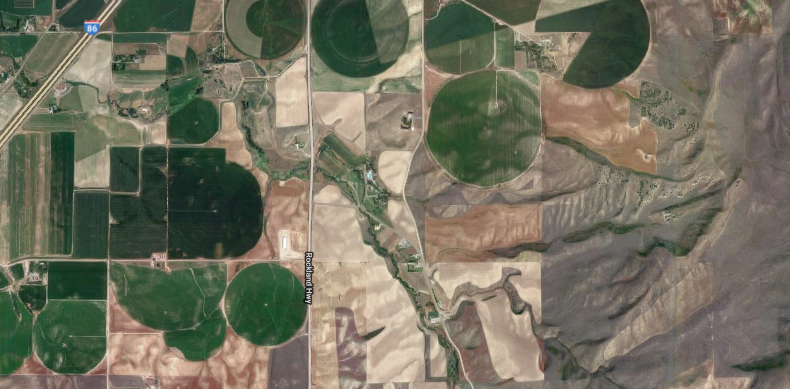
Enjoyably, this grant of land can be mapped easily to real property today. Here is a visualization thanks to the government:



Sunday, May 9, 2010

Mary Ella Hickman Prophecy and Fred's Dry Wheat Farming

In the "History of the Neeley Ward" compiled by Norma Christensen Weber in Legacy of Faith: Our Jubilee Year authored and published by the Public Affairs committee of the American Falls, Idaho Stake of the Church of Jesus Christ of Latter-day Saints in American Falls, ID in 1998 there is an interesting description of a prophecy given by a "Mrs. Kohlhep." The dating is difficult to tell, as Norma jumps from topic to topic, and not always in chronological order. The information proceeding the one with Mrs. Kohlhep is in 1934. If the following story was a Mrs. Kohlhep in 1934, it is difficult to know who it could refer to, since none were living in Idaho by that point that are related to me. However, there is good evidence that suggests it was earlier:
(1) The golden grain prophecy makes no sense in 1934 and would not have been ridiculous.
(2) Norma discusses the building of the OSL RR, which was in the late nineteenth century.
(3) Fred Kohlhepp is mentioned as introducing grain, and he died in 1919.
(4) Most importantly, she dates Mrs. Kohlhep's wosrds as coming true shortly after 1904 when the American Falls branch (this was actually in 1906) was established.

I think this clearly points to a late nineteenth century dating, and with the Kohlhepps being part of the ward, and the history noting Fred, it only makes sense that the Mrs. Kohlhep is Mary Ella. So on to the interesting account. It reads on page 36:

A Warm Creek irrigation company was formed and built wooden flumes to carry the water to all of the homes in the Neeley area, and each family bought shares according to their needs. There was much contention and back biting in the little ward over the water. Mrs. Kohlhep prophesied in tongues that if they didn't stop quarreling, it wouldn't be long before strangers would move in and take over the land. She also said that all of the land between Neeley and Rockland would be as one big field of waving grain. People laughed and thought her a little queer because there was no water for the land, and they couldn't picture raising grain without water. The Oregon Shortline railroad was built through American Falls which created a good market for wheat. Fruit orchards were planted. Stately lombardy poplars were planted for wind breaks. Our house was a log house with a sod roof and one year father was replanting his tulip bulbs and had more than he had room for, so he tossed the rest of the bulbs onto the roof. Much to the delight of everyone passing by the next spring, we had tulips blooming on our roof. Soon homesteads were being taken up and dry land wheat was being grown. Fred Kohlhep was the first of these to try the wheat. His home was just above Indian Springs on the Cold Creek. The old log school house was now too small, and so a new church was built in about 1899. The bricks were made and burned on the sight and were a soft orange red color. Clay from the warm stream proved to be ideal for this. Sandstone for trim came from the stone outcrop on the eastfork of Cold Creek. The new church was completed in 1904 and within a shorttime and when the church became a branch of the American Falls Ward, Mrs. Kohlhep's words had come true.

This account shows the prominence of spiritualism within the Kohlhepp family. I had read in some of Annalee Kohlhepp Skarin's mystical writings on how her mother prayed in tongues, but I wasn't sure what to make of the source. That this History substantiates Annalee's claims shows that Mary Ella was known to some extent for her spiritual gifts: prophecying and speaking in tongues. She was also known for them coming true to some extent, even if thought of as "a little queer." It makes it less surprising that Annalee thought she might have spiritual gifts herself, such as healing, and eventually as she conceived of it, the power of translation.

Besides this, it does note Fred being one of the first for introducing dry wheat farming into the region. It also notes where the Kohlhepp's home was: "just above Indian Springs on the Cold Creek."

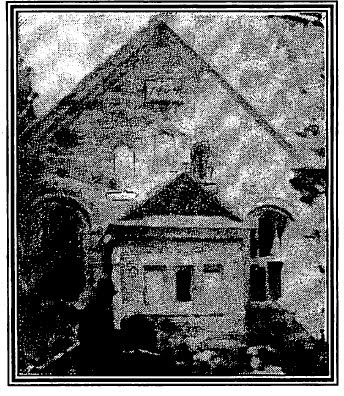
There are also some fun pictures of ward buildings and histories of the wards Fred and Mary Ella attended in the book. I have uploaded the account of the prophecy and ward building pictures below.